
The difference between a celebrant and a registrar is simple once you see it: they're doing two different jobs. A registrar makes your marriage legal on behalf of the council. A celebrant gets to know you and then designs and leads your wedding ceremony around you as a couple. Most venues set things up so one person does both, which is why so many couples never realise they get a choice.
I'm Zadie, your fun and modern UK wedding celebrant with lots of tips, guidance and ideas to give to you! The first thing almost every couple asks me is "but what about the legal bit?" So this post covers how each option works, what it costs, how the legal side fits around a celebrant ceremony, and a quick quiz to help you decide which suits you.
If you’re planning a non-religious wedding in England, you’ve got two options for who leads your ceremony. You choose your photographer, your florist and the person doing your hair, but the ceremony itself often gets overlooked as something to get over and done with before getting to the fun bit. Given that the ceremony is the heart of your wedding and the very reason you’ve brought your loved ones together, it makes sense to consciously choose the person leading this part too.
The legal bit and the ceremony are two separate jobs
Every wedding with a registrar has two things going on at once:
The legal part. A few required words, a declaration that you're free to marry, and your signatures in the register. This is what makes you married in the eyes of the law.
The ceremony. Everything else: the walk in, the words about the two of you, the vows, the rings, the moment your guests stand up and cheer.
With a registrar, both happen at once, in a format the council sets. With a celebrant, you split them. The legal part becomes a short appointment at the register office, and the ceremony is designed around you by someone you've chosen and got to know. You get to choose who does the part that matters most to you.
Splitting the two jobs also opens up where you can get married. A registrar can only marry you at the register office or a licensed venue, so if the place you love isn’t on the list, you either compromise or find somewhere else. A celebrant can lead your ceremony in a woodland, a back garden, a barn, a rooftop, a family farm. Anywhere that gives you permission.
So is it still a real wedding?
Yes. If you’ve got an Aunty Sue, Uncle Dave or Grandma Sally saying “it’s not the real wedding though”, you’re not alone. For their generation, the paperwork and the party always happened together.
But look at every other big life moment. A baby's birth is registered at an office within a few weeks, and nobody celebrates that date. They celebrate the birthday. A death is registered separately from the funeral, and no one would say the funeral wasn't real. Weddings are the only milestone where we've been taught the forms and the celebration have to happen at the same time.
The paperwork makes you married. The ceremony is the wedding everyone was there for, arguably the most memorable part. Explaining these separations usually gives them pause for thought.
The difference between a celebrant and a registrar at a glance
Celebrant vs registrar: side by side
| Registrar | Celebrant | |
|---|---|---|
| Their job | Makes your marriage legal | Creates and leads your ceremony |
| Who they work for | Your local council | You, the couple |
| Who you get | Whoever is assigned on duty that day | The person you chose and have got to know |
| Meeting beforehand | Usually only on the day, possibly one call before | Yes, multiple times through the whole planning process |
| What goes in | Set legal wording, with some room for personal words, readings and music | Your story, vows, guest involvement, rituals, music, anything that suits you, with expert guidance to shape the ceremony |
| Religious content | Not allowed | Can be included, often led by family or friends |
| Where | Register office or a licensed venue | Anywhere that gives you permission |
| Timings | A booked slot, often with another ceremony to get to | Built around your day. I take one wedding a day, so I'm never rushing off |
| Legally marries you | Yes | Not yet in England and Wales |
| Cost | Set by your council: around £630 to £940 on a Saturday at your venue | Set by your celebrant: £975 with me, including all the planning, a ceremony written from scratch and me leading it on the day |
Celebrant or registrar? Take the quick quiz
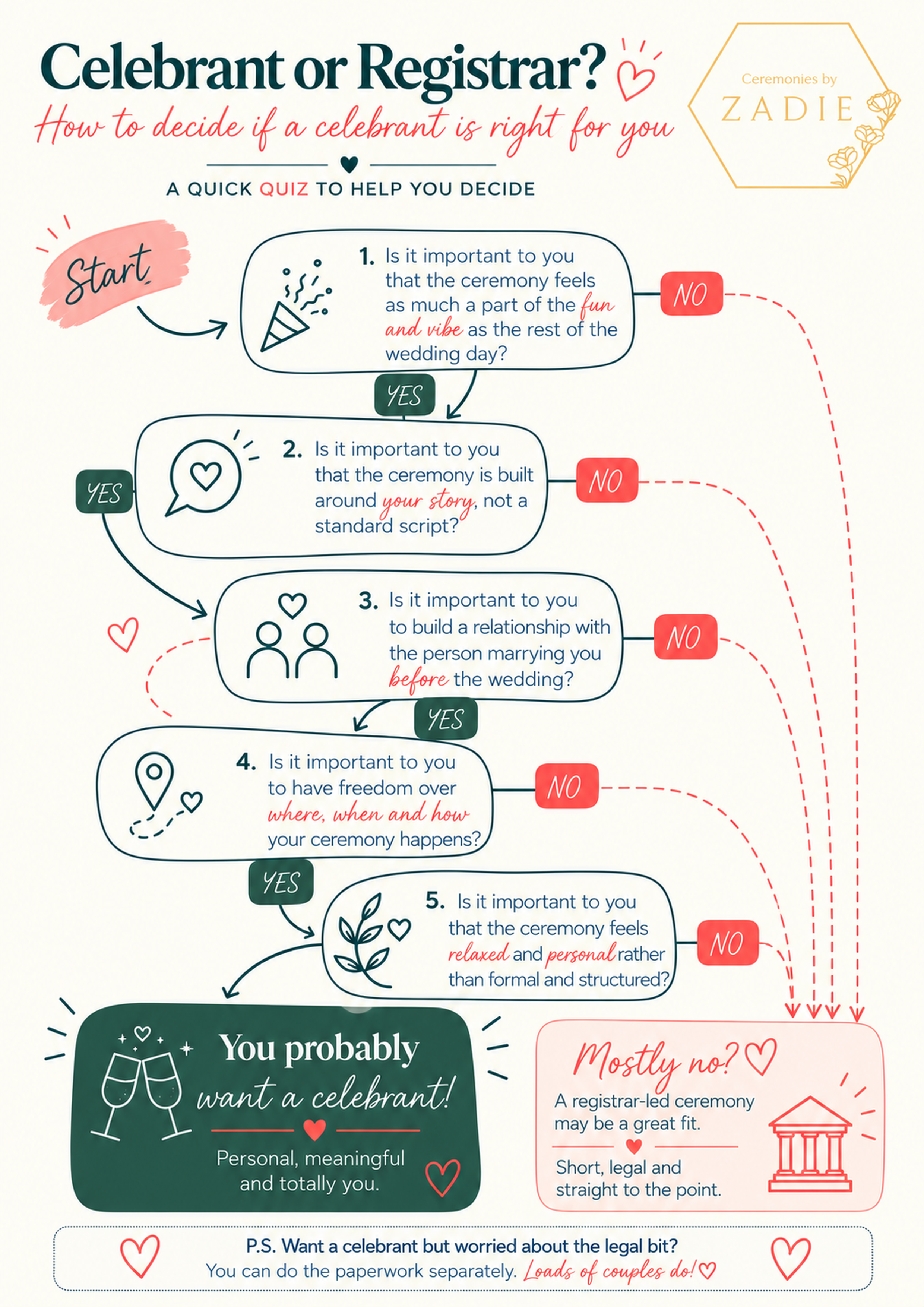
Answer yes or no to each of these:
Do you want the ceremony to feel as much a part of the fun as the rest of the day?
Do you want it built around your story, not a standard script?
Do you want to get to know the person marrying you before the wedding?
Do you want freedom over where, when and how your ceremony happens?
Do you want it to feel relaxed and personal, not formal and structured?
Mostly yes? You probably want a celebrant.
Mostly no? A registrar-led ceremony could suit you well: short, legal and straight to the point.
Want a celebrant but worried about the legal bit? You can do the paperwork separately. Loads of couples do, and the next section shows how.
Can a celebrant legally marry you?
Not yet, in England and Wales. The government has consulted on reforming wedding law, but nothing has changed so far, and Scotland and Northern Ireland have their own rules. I keep where marriage law reform stands up to date, so check there for the latest.
How the legal bit works alongside a celebrant ceremony
Give notice. You both visit your local register office to give notice of your marriage, at least 29 days before the legal appointment.
Book a short legal ceremony. The basic option at the register office is just the two of you and two witnesses, on set weekday slots. You say the required words, sign the register, and you're legally married.
Have your wedding. Your celebrant ceremony happens wherever and whenever you've planned it, with everyone there.
Most of my couples do the legal bit a few days or a week before. A few book the morning of the wedding, if a slot is free. Here's what they tell me afterwards:
The wedding day felt more relaxed, because the formal part was already done.
The legal appointment turned into a lovely, small moment with their closest people: a different outfit, lunch afterwards, and the excitement building for the big day.
Not one couple has said it took anything away from the wedding, or that they wished they'd done it differently.
Don’t fancy making a second occasion of it? That’s fine too. Ask for the simple two-witness option, turn up in jeans, and save the vows and rings for your celebrant ceremony. This way, it’s a bit of paperwork you’re ticking off the list.

Photo courtesy of Judyta Tyda Photography
Do you need a celebrant and a registrar?
You need a registrar to make it legal. You don't need them at your venue, and that's where the money question comes in.
The objection I hear most is: "We're already paying for the registrar, so why pay for a celebrant too?" Here's how the sums actually work.
A registrar at your venue costs around £630 to £940 on a Saturday across the councils near me (checked November 2026). Many venues add their own charge for the ceremony room on top. Have a celebrant as well, and you're paying in full for two ceremonies.
The basic register office ceremony is £62 (see current registrar fees on GOV.UK). Do the legal bit there, and the money you'd have spent bringing a registrar to your venue goes a long way towards a celebrant instead, with much better value for money (check the table above for examples).
That way you get both: a legal marriage, and a ceremony built around you, without paying for two full ceremonies.
Every council sets its own venue fees and they change each April, so check yours before you budget. You can see what my ceremonies cost and what's included on my pricing page.
Photo courtesy of Sarah J Scott Photography
What a celebrant gives you that a registrar can't
A registrar's job is to marry you legally and do it well. My job is to make your ceremony the part of the day people are still talking about at the bar. That means:
A ceremony written from scratch after getting to know you both, so your guests recognise you in every part of it.
Your guests involved, not just watching. Group vows where the whole room shouts "We do!", a game everyone plays, or a quiet ring warming. These are just a few ideas. The list is endless and we’d work together to design what feels right for you.
Laughter and emotion in the same 30 minutes, delivered by someone who knows how to hold a room. Before becoming a celebrant, I was an actor and worked in live events for over ten years.
No clock-watching. Obviously the hope is that everything runs to time. However, if there are any delays or last minute changes, I’m not leaving for another wedding. I’ll wait, make sure everything’s ok and even adapt the timings with your suppliers.
Early, calm and organised professional. I liaise with your venue, readers, musicians and coordinator so everyone knows their cues and things run smoothly.
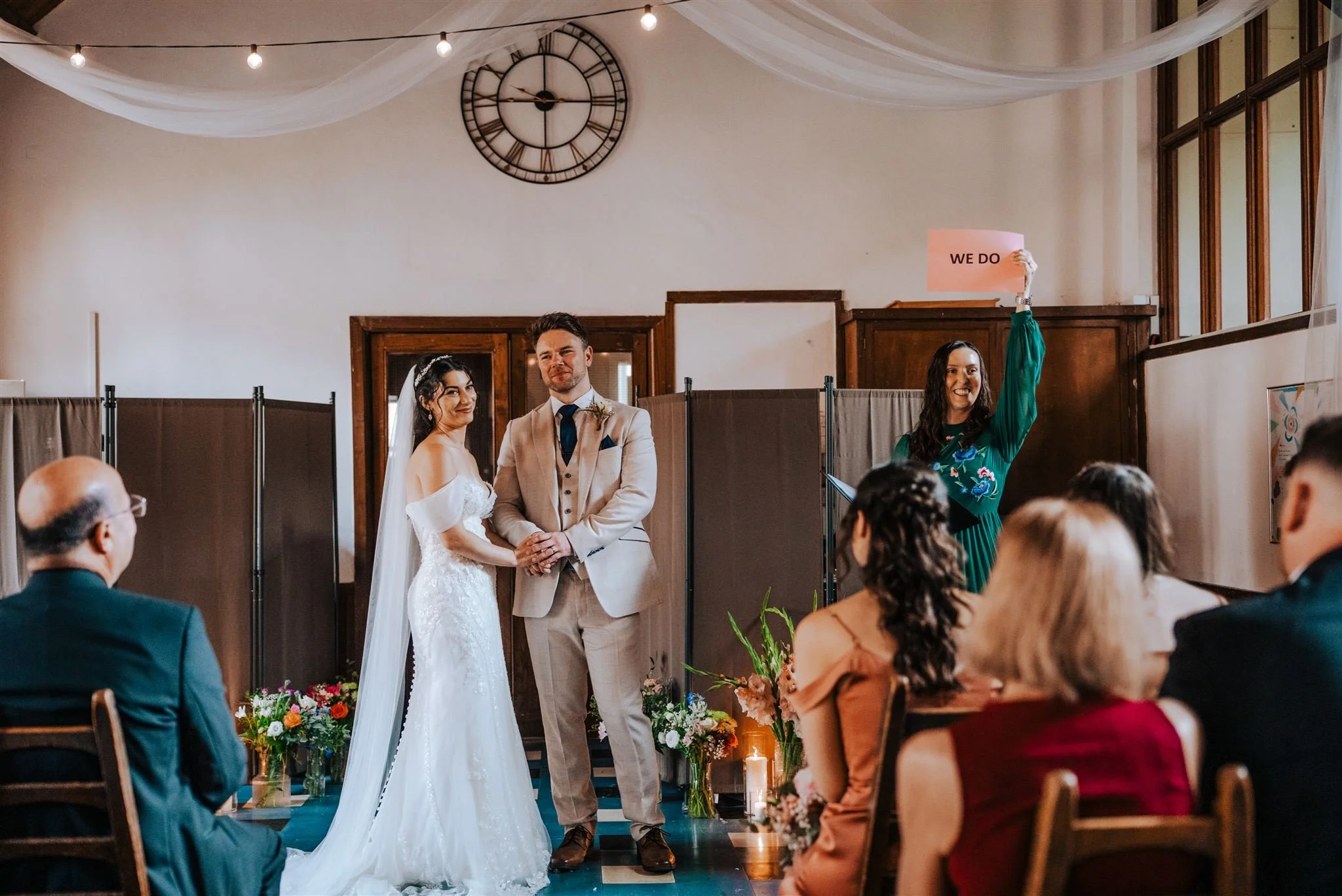
Photo courtesy of Alex Buckland Photography
What could that actually look like?
A ceremony at dusk under festoon lights in a field. Your dog trotting up the aisle with the rings. A walk-in to the song that played on your first date, with the whole room singing along. A themed ceremony built around the film you’ve watched twenty times.
Or something quieter and more relaxed: everyone holding the rings for a moment before you exchange them, or a traditional format with your story and personal vows added.
If it suits you and your venue says yes, we can build it in.
If you'd like to see what that looks like in practice, here's how I design a ceremony, from first call to wedding day, and 24 ideas to personalise your ceremony. You can also check out a video of one of my ceremonies on my weddings page.
Photo courtesy of KJA Photography
When a registrar is the right choice
A celebrant isn't for everyone, and that's fine. A registrar is the better choice if you want something short and simple, the ceremony isn't the part of the day you care most about, or you mainly want to be married and get to the party.
Registrars cover births, deaths and citizenship as well as weddings, and plenty of them are lovely. Just know that they work for the council, not for you, and you won't usually know who you'll get until the day. So you won’t know their tone, their energy or how they’ll read the room until you’re standing next to them.
So, celebrant or registrar?
If you just want to be legally married, a registrar does the job. If you want your ceremony to feel like the start of the celebration, not the admin before it, that's what I do.
Download my brochure to see how I work and what's included, or get in touch for a Vibe Check call and we'll see if we're a good fit. I only take one wedding a day, so it's worth checking your date early.

Photo courtesy of RoxPix Photography
FAQs: Celebrant vs registrar - your questions answered
Is a celebrant the same as a registrar?
No. A registrar is a council officer who makes your marriage legal. A celebrant is someone you hire to create and lead your ceremony. To add to the confusion, some councils call their own registrars “celebrants”, so check who you’re actually booking.
Do we need a celebrant and a registrar?
You need a registrar for the legal part. You only need a celebrant if you want the ceremony built around you. Plenty of couples have both, with the registrar as a short appointment at the register office and the celebrant leading the wedding itself.
Can we do the legal bit on the same day as our celebrant ceremony?
Yes, if your register office has a slot that morning. The basic appointments are usually on set weekdays, so most couples do it a few days before. You can also book a registrar to come to your venue, but that costs a lot more and means two ceremonies on the day.
How much does a registrar cost?
The basic register office ceremony is £62. What a registrar charges to come to your venue is set by each council, and costs around £630 to £940 on a Saturday near me (checked November 2026). Your local council’s website has its current fees.
Who needs to be at the legal appointment?
The two of you and two witnesses. Some register offices have room for a few more people, so ask if you’d like parents or close friends there. Wear whatever you like.
Can we include religious or cultural traditions?
Yes. A registrar ceremony can’t include religious content, but a celebrant ceremony can. That could be a family blessing, a reading or a cultural ritual, often led by a relative or friend. I won’t lead worship myself, but I’ll help you weave in the traditions that matter to you so they sit naturally in the ceremony.
What if we need to change our date or venue?
With a celebrant, let me know as early as you can and I’ll check my availability. I only take one wedding a day, so dates do go. With a registrar, it’s usually more complicated: if you change your venue after giving notice, you’ll normally have to give notice again and pay the fee again.